My name is Hannah Thomson and my blog aims to address the gendered nature of justice in our modern world, particularly that of sexual violence and the portrayal of victims in the media. Discussion is welcome, so please feel free to comment below.
Justice is Gendered.
The truth of the matter is that criminal justice and the way a crime, an offender and most importantly a victim is portrayed by the media and in society, is heavily influenced by gender stereotypes and expectations. Thinking that men should be dominant and women, submissive, are notions one would see as outdated. However media and societal reactions to recent rape crimes have confirmed that these ideals are very much still prevalent when it comes to criminal justice.

This is a barrier that society and the criminal justice system needs to overcome. To acknowledge notions such as men can be victims of sexual violence, and that women do not have to wear longer dresses to not be raped. To do this, society must come to disregard gender as a factor in crime and further refute theories a victim is complicit in their victimisation.
First, we shall explore the theories that paved the way for victim blaming.
Early victimisation theories and victim blaming
Marvin Wolfgang’s victim precipitation theory suggests that the victim of a crime is in some way complicit in their victimisation through participating in, provoking, triggering or promoting their own victimisation. From this theory, Von Hentig (1941, 1948) and Mendelson (1956) took it even further to establish a scale of accountability a victim has in their victimisation, ranging from ‘guiltiest’ to ‘guiltless’.
Lifestyle exposure theory, is another key theory in terms of victimology, theorised by Hindelang, Gottfredson and Garofalo (1978) which closely examines the relationship between socio-demographic characteristics and the likelihood of victimisation and concludes that it can be attributed to the personal lifestyle of victims. For instance, an individual in a dangerous place is more likely to fall victim to a crime then a person who is in a respectable place. A characteristic explored within this theory that is expected to increase an individuals chance of victimisation is gender. Hindelang, Gottfredson and Garofalo see a fundamental difference in the societal roles and oppression of men and women leading to a difference in the way each respective gender should carry out basic activities with varying degree of supervision, contact with strangers and high risk places to be. For example, based on gender stereotypes, Hindelang, Gottfredson and Garofalo believe that should have increased supervision in public and spend more time in a domestic environment, as opposed ti men who are seen as more assertive and then should have fewer restrictions in their day to day lives.
A final theory I’d like to address is Cohen and Felson (1979) routine activity theory, which has many similarities to lifestyle exposure theory, emphasises that patterns in lifestyle or ‘routine activity’ provide vulnerability to the occurrence of a crime. Cohen and Felson believe that the victimisation occurs when these three key elements converge in time and space; a motivated offender, a suitable target and the absence of a capable guardian and that further to prevent criminal activity, there would just need to be a lack in any of these. The gendered implications of this theory is that men would typically be viewed as ‘capable’ of being their own guardian whereas a women requires supervision during her daily routine activities to prevent their victimisation.
In proposing that a victim is a causative element in a crime, early victimology theories such as victim precipitation theory, routine activity theory and lifestyle exposure theory, uphold victim-blaming views that are no longer deemed credible. Despite this, concepts that emerged from these theories are still very much present in a contemporary setting, particularly in the media.
The case of Eurydice Dixon

The rape and murder of Eurydice Dixon was one that divided the nation, sparking debates as to the accountability of each gender in violent sexual crimes. If you are not familiar with the case here is a link to a Guardian article: https://www.theguardian.com/australia-news/2018/jun/19/eurydice-dixon-death-male-rage-australia-women-men-attitudes
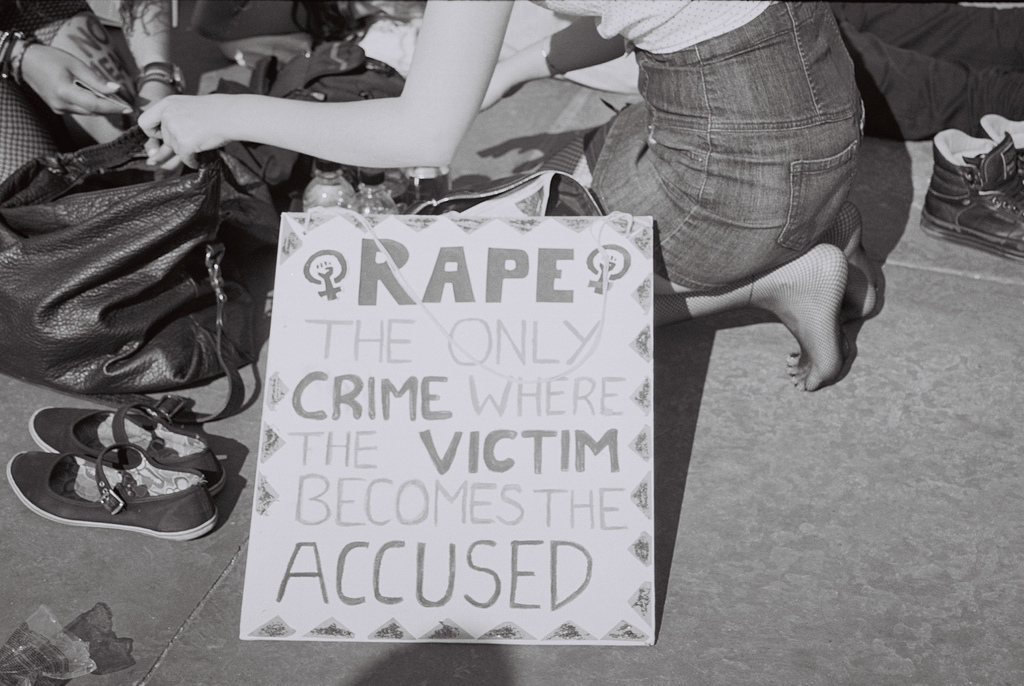
Many were quick to criticise Eurydice for being alone late at night in a park by herself, and the all too familiar advice from police for girls to have “situational awareness” by doing things like carrying your mobile phone and not wear headphones when walking alone. This was followed by fury from women at the implication that the onus was on them to modify their what they say, do and wear to prevent their own victimisation, rather than addressing and changing the underlying social issue of men having more respect for women.
But this isn’t the first time that women have been portrayed to be accountable for the violent crimes that have befallen them, nor do I expect it will be the last. However one thing is certain, the presence of gender stereotypes in criminal justice and subsequent victim blaming must end. Boys must be taught that they are not superior to girls, and that dominance and violence towards women is not acceptable

Sources & images
Alcorn, G., 2019. Eurydice
Dixon: how one woman’s death put focus on ‘male rage’ in Australia. [Online]
Available at: https://www.theguardian.com/australia-news/2018/jun/19/eurydice-dixon-death-male-rage-australia-women-men-attitudes
Clarke, D. B. C. &. R. V., 1986. The Reasoning Criminal: rational choice perspectives on offending. New York: New York : Springer-Verlag.
Miethe, R. F. M. &. T. D., 1993. Understanding Theories of Criminal Victimization. Crime and Justice, Volume 17, pp. 459-499.

 Hannah's Blog